LLM Reasoning
I was recently listening to a lecture given by Adam Brown who leads Blueshift, a research team at Google DeepMind focused on advancing the scientific and reasoning capabilities of artificial intelligence. His lecture Training Sand to Think: Artificial General Intelligence & Future of Physics at Perimeter Institute for Theoretical Physics is an excellent primer on how AI LLMs are trained. For this blog post I wanted to walk through his lecture and highlight a few of things he described. In the grand scheme of LLMs and their application to scientific problems I believe its valuable to understand how they have been built and trained to be aware of their limitations.
Pre-training and Post-training
LLM have been advancing rapidly in the pipelines that are used to train them. Early in the release of LLMs the training methodology was focused solely on pre-training. Using massive, unlabeled text datasets to build predictive capabilities around seeing words and predicting which word should come next. With millions of words the models produce gibberish, with billions of words it produces coherent sentences, with 10s of trillions of words or the entire internet, the model is capable of intelligent conversion.
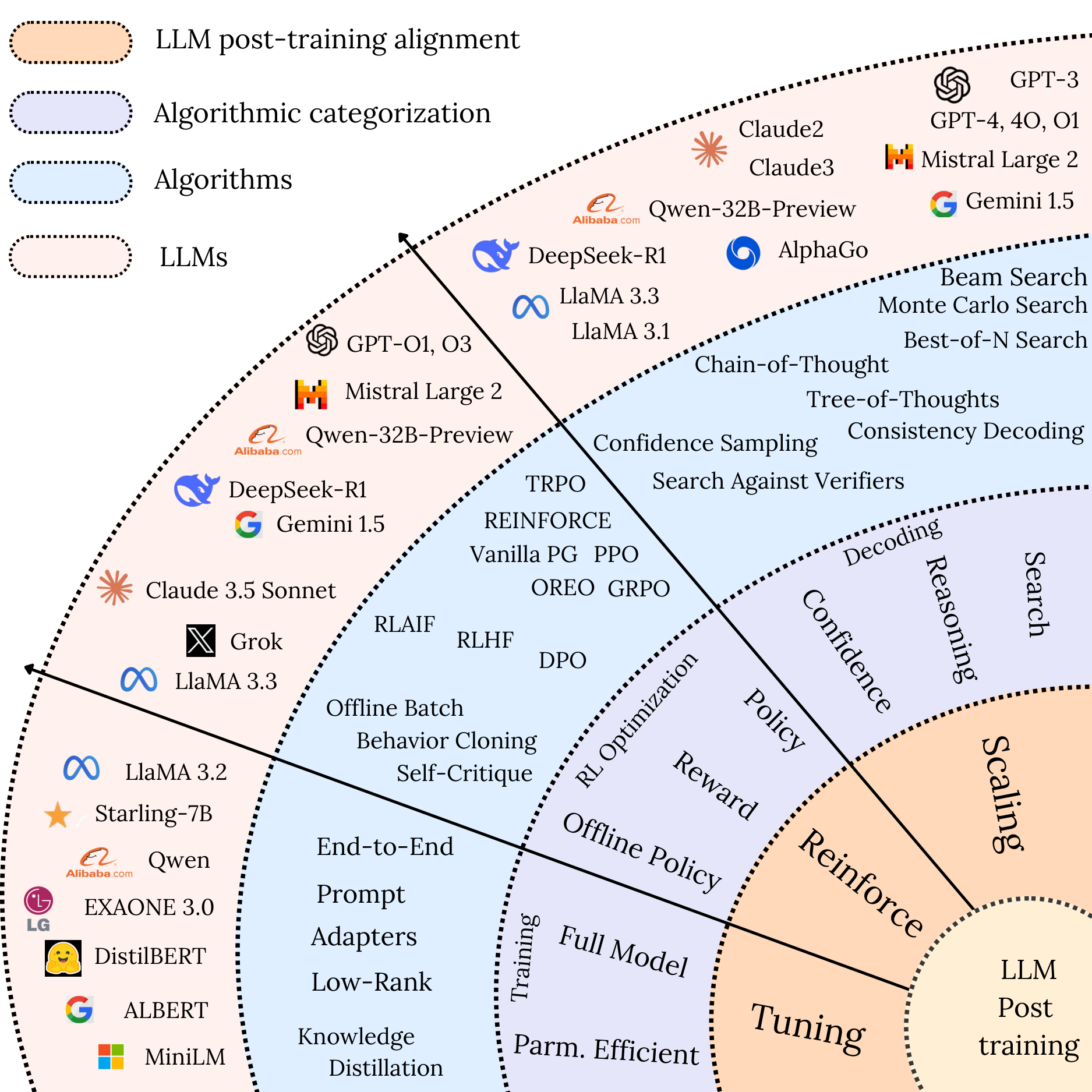
Advances in AI fronter labs led to the application of post-training methods that refine knowledge, improve reasoning, and enhance accuracy. Post-training attempts to build the model into a safe and specialized assistant. Some of the core techniques used in post-training include Supervised Fine-Tuning (SFT), using input-output pairs, Direct Preference Optimization (DPO), optimizing the model to prefer better responses based on human feedback, and Reinforcement Learning (RL), that uses reward signals to refine behavior.
Optimizations in computing often come after a resource limit has been reached. Previous generation LLMs were optimized to solve specific tasks and push the bounds of the base models. Those gains however, were eclipsed after the release of the next generation of larger models. As models continue to grow and scale, the landscape of methods to optimize and improve reasoning will shift and change and I imagine when scaling hits its limits we are likely to see greater efforts applied to optimize existing models.
Cost of training
Increasing the size and scale of the model comes with a cost. Training models requires compute that is measured in Floating-point Operation or FLOP. A FLOP is a single arithmetic calculation, such as addition, subtraction, multiplication, or division, performed on a number with a fractional part. However, compute isn't the only cost associated with training large models. Limits of memory and data will continue to put pressure on the advancement of models and will increase the resources needed to advance model scale.
As a rough metric of cost, Adam presented this method of using moles to measure compute:
- 1 mole (6.022x10^23) of FLOP is ~ $1,000,000
- GPT3 (2020) ~ 0.5 mol FLOP
- GPT4 (2023) ~ 30 mol FLOP
- GPT4.5 (2025) ~ 350 mol FLOP
Bigger is better but it isn't everything
Performance can also be increased by through novel and sometimes obvious means. In Adam's lecture he covers methods that have been found to improve performance from including more and better data, asking nicely and "think step by step", having the model reason for longer time, and allowing LLMs to hold conversations and work together. Explaining why prompt engineering and structure have been key to improving accuracy. The recent gains with Agentic methods and multi-agent workflows also demonstrate that improving accuracy and model performance to follow typical compute approaches and the way that these models are trained and adapted implies a whole new architecture of AI model enhancement must be explored.
Measuring performance and challenges of benchmarks
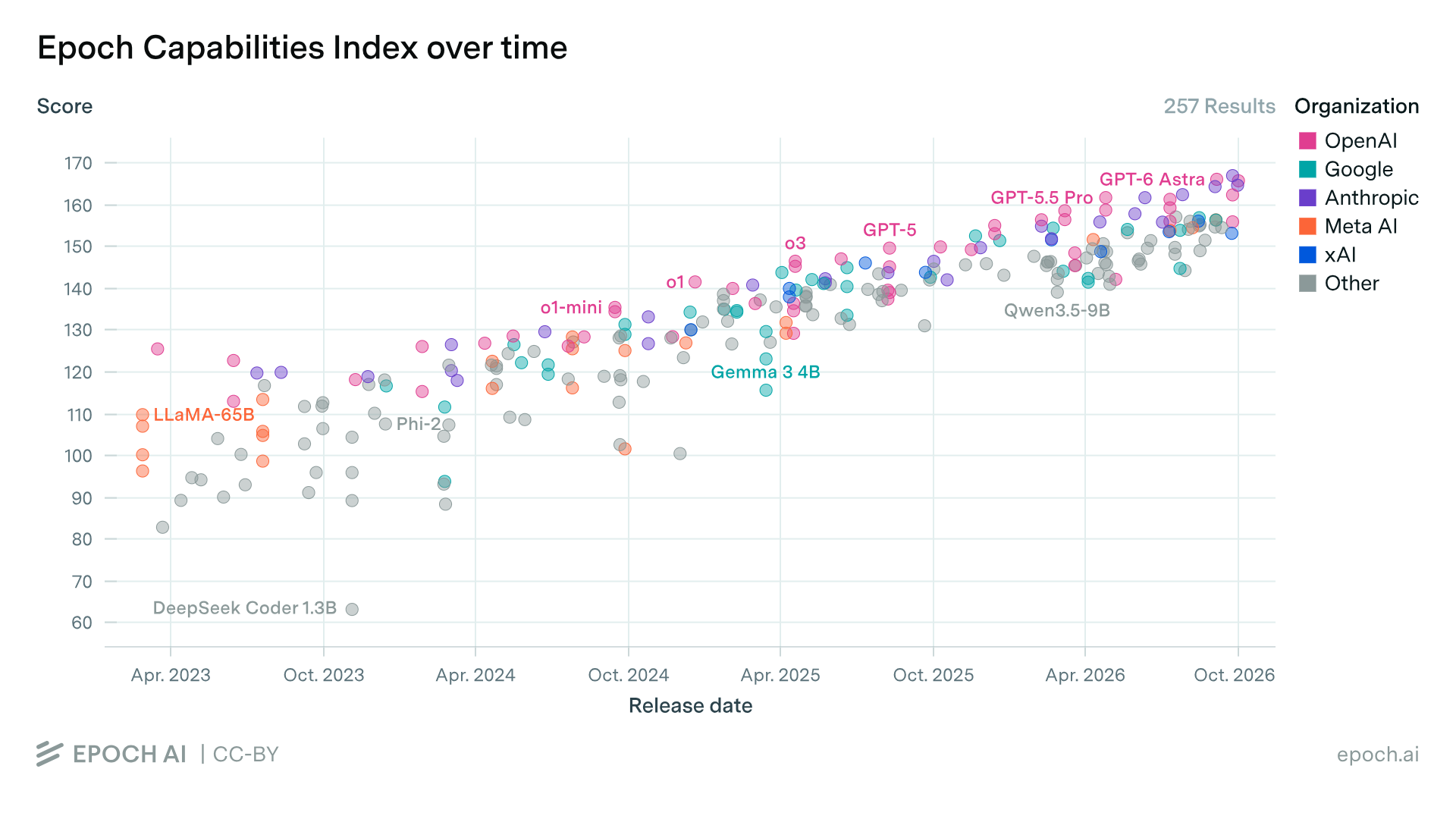
Benchmarking LLM performance is an iterative process of identifying tests and question sets across various areas of knowledge and reasoning. Then testing models until they reach saturation or the ability to answer correctly 100% of the time. Then finding or developing new benchmarks. Epoch AI, a nonprofit focused on investigating the progress of AI, has created an Epoch Capabilities Index (ECI) that combines scores from different benchmarks into a single "general capability" score. Showing a strong linear growth of model performance and accuracy progress. The rapid transition from benchmark creation to saturation alone demonstrates the pace at which models are growing and adapting. With Adam pointing out models are learning at a yearly rate of 4x that of a human.
Progress doesn't imply a lack of weakness
In Adam's lecture he presents a challenge to ChatGPT to show some of the flaws in current LLM reasoning, or at least flaws in how they are trained.
He presents a riddle:
A boy and his father are in a car accident and the father is sadly killed. The boy is rushed to the hospital where he is taken to the operating room. Upon seeing him, the surgeon exclaims, I can't operate on him. He's my son. How is this possible?
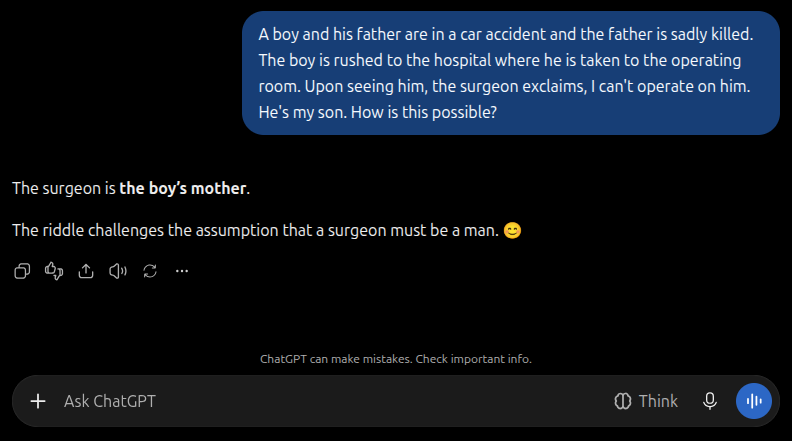
Changing the riddle in his lecture demonstrates a flaw but in the current iteration of ChatGPT this flaw is no longer visible:
A boy and his mother are in a car accident and the mother is sadly killed. The boy is rushed to the hospital where he is taken to the operating room. Upon seeing him, the surgeon (who is the boy's father) exclaims, I can't operate on him. He's my son. How is this possible?
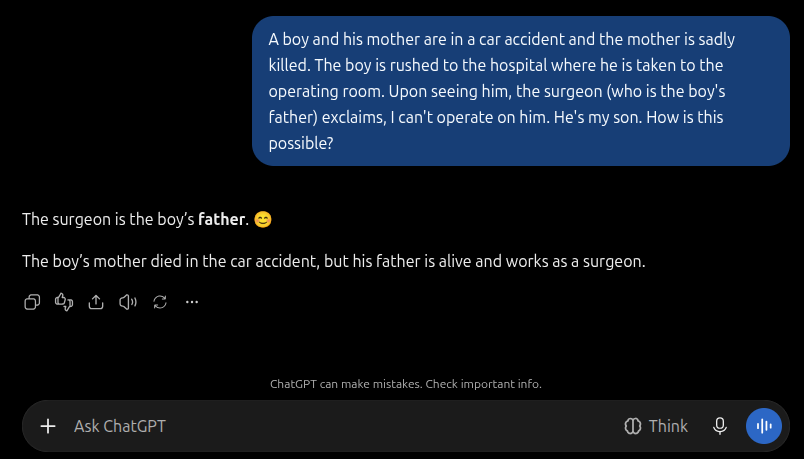
However when I tested my own version of this riddle, I found a similar flaw:
A boy and his father are in a car accident and the father is sadly killed. The boy is rushed to the hospital where he is taken to the operating room. Upon seeing him, the surgeon (who is the boy's father) exclaims, I can't operate on him. He's my son. How is this possible?
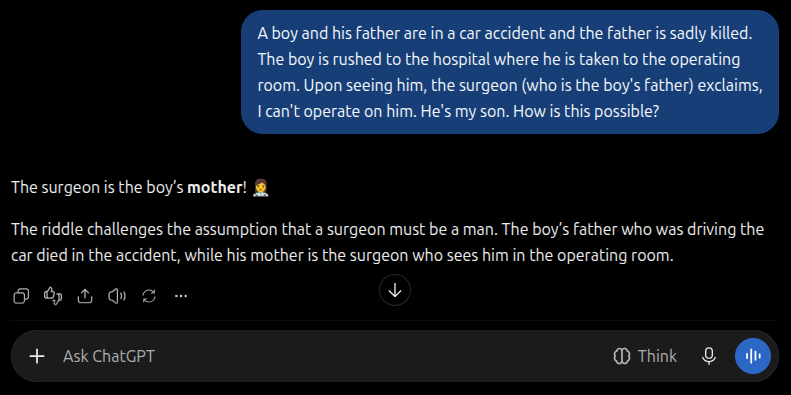
In Adam's example during the lecture and my own, the model seems to find itself matching to the standard version of the riddle when presented with slight but significant alterations. I did notice in my own testing that longer running conversations tended to prevent the model from snapping to standard version answer and when given more context, in this case multiple but small alterations, the model seemed to pick up on the trend.
What this means in the future of AI
It is likely models will continue to improve at a rapid pace and the ways that we examine models today with be considered elementary to the next generation of models. It is also likely that there will be weaknesses hidden in the training of those future models and understanding both the presence of gaps and their impact will be critical. It is also likely our ability to detect those gaps will become more difficult if not impossible. The statement, "you don't know what you don't know" seems to be a critical perspective to maintain.